I’ve written a small silly book about growing up on a farm in Mid Wales. I’ve had around 50 copies printed which I’ve distributed to friends and family. Found it interesting the people that have got something out of the book and enjoyed, some of those don’t have a background in farming, and don’t know my family.
My plan is to publish the first couple of chapters on this blog. If you would like a copy please get in touch. After finishing it around December 2024 I have taken 6 months before sitting down re-reading and trying to work out what it is.
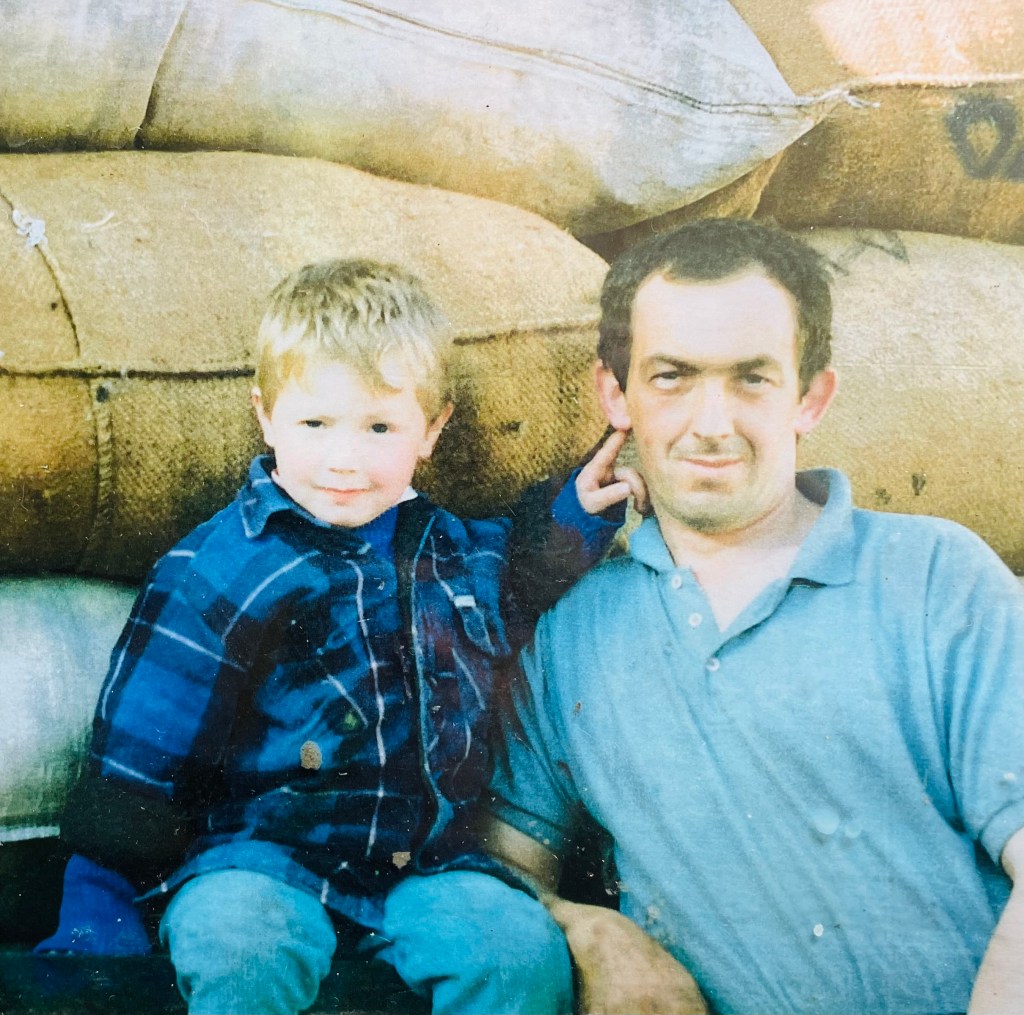
Gelynos: Not a proper hill farm
Introduction
The following was written as a distraction piece, in principle for the three to four readers but in reality for the writer.
We weren’t a book family growing up. When I was 9 years old I remember having New Years Eve with Dad’s friend Neil and his wife Caroline and when asked if she had seen the new Bridget Jones’ Diary film Caroline replied “No, but I have read the book”. To this we all let out a collective “ooohhh, you’ve read the book” which does well to sum up our relationship with the craft.
On the surface it’s about farming, the uniqueness of this upbringing and the simple stories it leaves with you that make you see the world through a slightly different lens.
As dad is central to the farm he inevitably becomes central to the book. A quick story to introduce him. Despite having two indoor toilets in our farm house he chooses to poo outside regardless of the weather, in what we would call a Ty Bach. It is perfectly functional, no heating, but flushes. It was built around 15 year ago when a pipeline was passing through the valley and dad saw an opportunity. Allowing a couple of the digger drivers to stay in a caravan above the house.
Following his morning movement outside he comes back inside for a coffee before beginning his day. On a recent return he began discussing the swallows that had chosen to nest on the beam above his head. Some people would be annoyed at the bird muck that ends up on the floor of his ensuite but he enjoys their company.
He then began to explain how he watches their lives progress each day as they look upon each other with trust and affection, he climbs up to check for eggs, once rescuing a young chick that had fallen to the ground, watching them watch him as these young chicks leave the nest and work their way across the beam staring down with interest. He ends by explaining how he is annoyed that they have now flown away and don’t return to see him in the morning, I’m unsure what this book is really about but I’m confident it’s to do with this.
There will be people who question my retelling of stories, my interpretation of the strategy of the Gelynos farm. To those people I say if you aren’t happy with it, Dad, write your own book.
Final bits of housekeeping, I sometimes refer to dad as Gary, they are one and the same, I’ve always done it. He thinks it stems from a lack of respect, its not that, also it contains swears.
Chapter 1: September
Dadcu telling us how after his first day of school he got back and told his parents
“It was okay but I don’t plan to go back again”
Mum
“But Dadcu you had 5 older sisters, surely you knew you would have to go back?”
Dadcu:
“Well I guess I just thought I was special”
Gelynos
Gelynos like most Welsh farms is a Welsh word, but nobody is quite sure how it translates, some say ‘Nos” being night and potentially Gel being sheltered. My favourite explanation is that it translates to “built in a night” from a myth that if you could have a fire burning by the morning all the land you could throw an Axe on was yours. This makes little sense however would explain the questionable electrics and lack of en-suites.
We have expanded by renting neighbouring farms when they have become available. This now includes 2 other farms, Cefn Rhosan Fawr (Bend Ridge Big) and Llynneath. Mum inherited Cwmysg when her parents passed away, which overlooks the main road going in to Sennybridge. Dad often describes himself as a tarmac farmer, and jealousy is reserved for those fortunate enough to farm in one block.
The farm is mainly sheep, with cattle on the side. This style of mixed farming benefits grazing patterns, spreading muck and also if lamb prices are on the floor you can cross your fingers that the cattle will sell well.
Bonnie waiting on the Quad
Sheep
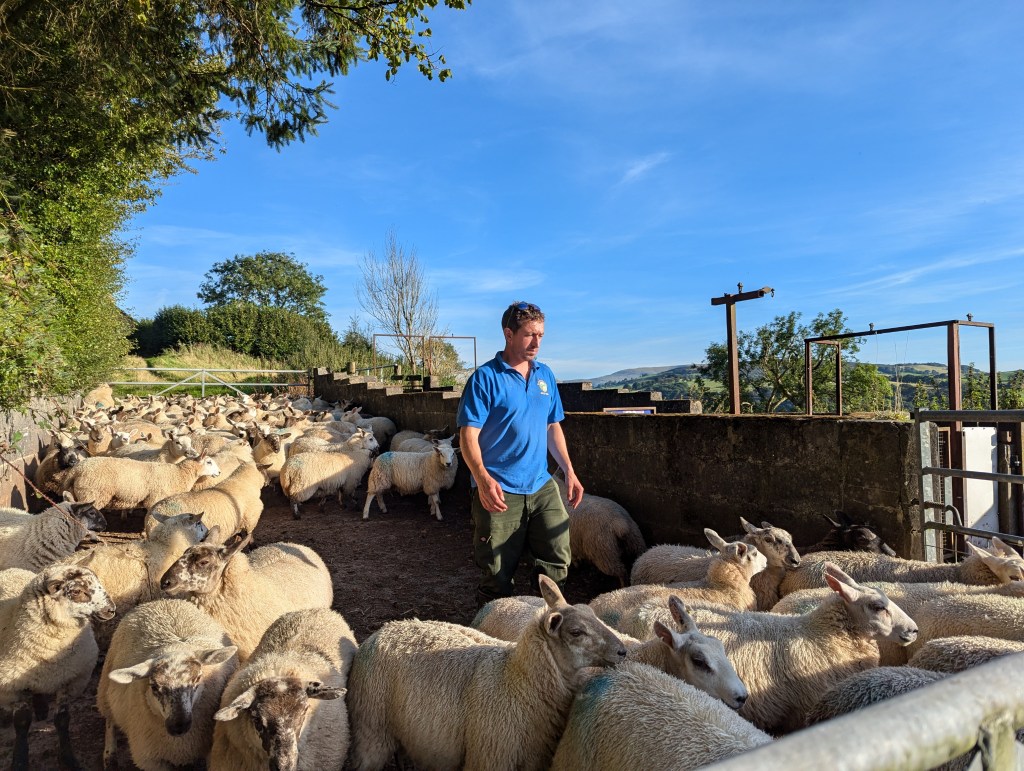
Autumn is arguably the quietest season on our farm, we use the time to complete our annual stock check. Given the ewes will have now been weaned we sort through them to decide which sheep will leave and which will remain. Involving a dental and physical of all breeding ewes.
You pull the lips apart to check if they have any gaps in their teeth or have been ground down after years of eating grass and swedes. This is followed by a quick grab of the boobs to check they are all working. Ewes will have occasionally suffered from mastitis since lambing and are no longer suitable for breeding. Placing your hand on an infected udder can put you off clotted cream scones for life!
We check the physical condition by feeling for fat on the back. They might be looking good now but Winters are hard, at the top of our farm you are around 1300ft above sea level. We’re thinking “can they do it on a cold rainy night in Stoke?”
Acceptable criteria varies year on year based on farm finances. You ideally want to maintain a similar number of sheep each year and each new sheep into the farm will cost you more than each old sheep out. I’ve seen us give the benefit of the doubt to a sheep based on some increasingly obtuse reasons such as “she has a nice face.”
Dad tells a story annually of a farmer who has replaced this job by walking his sheep up a steep field, he shuts the gate when he feels they are getting a little slow and all those that haven’t made it into the top field will leave the farm shortly after. This approach sounds daft until after prising open the mouths of 700 sheep, it’s then you begin to think he might be onto something. Often you find a sheep with a loose tooth that dad would hand over as a gift. I would then take this tooth and place it under my pillow whilst trying to fool the tooth fairy* out of another 50p. Never worked.
We’re always checking for yearlings that are changing their teeth and only temporarily have a gap. It is the equivalent of sending a teething toddler to an old people’s home (if the old people’s home was a kebab house).
The ewes considered surplus are taken to lower ground in a field out of sight to gain a little more fat before being sold to market. There historically was no market for this type of animal however mutton has found a place and is now used in the curry and kebab houses across the country. The chosen ones are taken to higher ground, leaving the good grass for the lambs.
*A slightly too old Fiona once woke up in hysterics having discovered the tooth fairy hadn’t been, following a dental operation during which she had asked for the tooth back. My mum was distraught, having assumed she no longer believed in the tooth fairy. The following night mum sneaked into Fiona’s room to place 50p under the pillow only to find a note explaining how she knew it wasn’t real but still wanted the cash going forward.
Two of your best, please, governor
Hill farms aim for one lamb per ewe due to lambing outside, whilst some lowland nonconformists dream of three plus lambs per sheep. We, however, aim for two. A sheep’s udder has two quarters, so two lambs seems sensible. The system is built and decisions are made for a ewe walking out the shed with a healthy pair of lambs in March.
When we select our ewe lambs to join the flock we choose those that were born twins themselves, which increases the odds. Tups are often advertised as being born a twin, but Gary often ends up buying the one that looks more DeVito than Schwarzenegger.
Flushing
Alongside this we do a thing called flushing. The ewes who have spent the summer on higher ground following weaning are brought back down from the hills and introduced to lots of green grass a few weeks before D day. The aim is to convince the sheep that this is going to be a great year and they will happily manage two lambs if they are fortunate enough to happen upon a tup. Fiona, who herself would like twins, often describes her plan to one day “flush herself” by spending a few weeks in a calorie deficit before returning to Gelynos to fatten on a diet of fried bread and sponge.
Tups
We then round up all the tups currently under farm ownership, finding them kicking their heals under hedges, playing cards, smoking fags. At this point you struggle to picture the tanned adonis you fell for 12 months ago at last years tup sale.
Horns Under The Hammer
You can buy tups directly from the farm, however most prefer the excitement of an auction. A nearby town of Builth Wells hosts one of the largest tup sales in the UK. Tanned, trimmed and full of testosterone tup breeders are cut from a different cloth. Its a risky business, costs are heavy behind the scenes, expensive ewes, expensive tups, vets bills (large lambs = caesareans) and the success of your venture will come down to a single big sale. If you can average your chosen 30 tups at £1000 you can call the day a success but £600 average and the whole year has been a bit of a disaster. The day before potential buyers are invited for a wander around to view the stock. Whilst talking to the tup breeders you can smell the tension, by this point someone will have been around judging best in sale, best pen of tups, most straw used. Etc. These rosettes hang proudly behind their representative pen, leaving you to guess which tup won which prize.
Everyone wants their tups to be auctioned in the middle of the sale, not at the start as most people are still queueing for the bacon roll, and certainly not at the end. Dad bought some good tups cheap last year, as the previous seller had achieved an astronomical price, and following his final tup, many people left the ring for a coffee. When dad found the tup breeder that he had purchased 2 off, he remarked “Now I’m sure they went cheap given you’ve bought two”
Dark Arts and Cabbage Farts
To achieve the most money for their stock, breeders will do all they can to alter the odds. Tups are dyed a dark orange colour (Mr Universe) trimmed to exaggerate the big bits and signs are made telling farmers that these rams have never even seen a cabbage, don’t know what they are, wouldn’t eat it if you put it in front of them.
Like all industries, reputation counts, farmers like dealing with farmers they know and trust, there was a guy at the last sale explaining to his friends that he had spent much of the previous week pulling gorse from the fleeces. The joke being that these fat nosed Suffolks had not seen sunlight and had instead been encouraged to stay in the shed eating feed, not wasting calories on cardio. This becomes an issue when they join the ramblers society and are asked to chase 300 sheep across a poorly fenced welsh hill farm.
If you are buying a hill tup (Cheviot) the whole experience is even more opaque; they apply shoe polish to the noses and chalk the bits they want to keep white. Given the perfect tup is a little harder to identify this can lead to confusion amongst the naive, and even the well informed.
Once you have carefully chosen the tups you want to bid for (biggest you are likely to afford) you stand, bid, win, luck money*, bacon roll and instant coffee, cheque book, then get them in the horse box and home.
*Luck money is the seller slipping £20 to the buyer as a gesture of good luck. Dad will do this when selling a pen of lambs and expects the same in return after purchasing a tup.
Once home you open the gate and introduce them to your current tups, who immediately size each other up and when you go out in the morning one of them has got a bit of a bloody nose following a smash up. You hear the horror stories of waking up to find your old tup standing victorious over an expensive new lowland tup.
Just into the cup
Next up is the club medical. An empty scanning is the type of horror story that keeps sheep farmers up at night.
Tups bought at a sale will usually have had their fertility checked in advance, but its good to get your existing older members checked.
It requires two people to hold onto the tup, a retired vet to hold the cup (and direct the penis), with my role being to shove an electrocuting dildo up the tup’s bum and press the shit covered red button. The vet* begins a count. I was told to press on 1 and hold till 3 by 3 the tup will have filled the cup. After examining the 4th Ram she (the vet*) made the comment that his balls looked uneven and this was a bad sign. She made me press the button three or four times before admitting that it didn’t look good quality. The results backed up this finding and the ram was forced to leave the flock on medical grounds.
*Still to this day have seen no evidence this lady was or had ever been a vet. Not a certificate on the wall or anything. Also, just to be clear I didn’t volunteer for the role of dildo holder it was just how the dice fell.
Teasers
Now you are left with your sheep who are fit and ready and your tups all warming up on the sidelines, threatening to get ill or drop dead for no reason.
With a few exceptions such as the Dorset breed, sheep are only capable of getting pregnant in the late summer early Autumn and they come into their cycle around once every 17 days.
We have recently started using “teaser tups” who are a warm up act for the main show. Helping them all lamb in unison by bringing them into season. These tups have had a vasectomy that is conducted by a real vet, not like the aforementioned fertility clinic. They have no idea that they aren’t fertile and when we come to take them away shortly after the real McCoy arrives they don’t come quietly.
Pip, Me and Robyn Removing the Teaser from the bunch
Rule of Three
For tups, Gary goes by the rule of three:
1 tup per bunch = High risk if he isn’t working
2 tups per bunch = they follow each other around all day fighting over the same sheep
3 tups per bunch = the two that follow each other around fighting spot the third doing his job and realise this is a better use of everyone’s time.
We budget around one tup per 60 per sheep, occasionally throwing in the odd tup lamb after around 8 weeks to clear up any that have missed or if a tup has stopped working.
Corn
Impatience has meant that instead of hiring a person to combine the barley and oats, Gary has bought himself an old combine. This broke down and having learnt his lesson he bought himself a slightly older combine before this broke down too, so he bought himself a third one. He once called me up at work to let me know he requires a new part for his combine, which was “very close by and will fit in the car easily”. I arrived a long while later to discover a very big part, and after squeezing it into my car I went inside to pick up the VAT receipt (don’t ever forget the VAT receipt). Inside a woman was drinking coffee in the corner. With unblinking eyes she began questioning me about combines, she explained that she loved Class Combines, not all combines, just Class ones and how she takes photos of them in the field.
*The Capital C isn’t a typo, it’s a machinery manufacturer.
Still annoyed that Gary’s combine sieve had left me with damaged upholstery, when she asked if she could take dad’s number and if he would allow her to take photos of the combine in action. I knew that there was nothing he would hate more, so quickly gave up his number, checking twice that it was written down correctly. On the way out of the building she followed me to the car showing me the photo book that she sells. As she opened the car and began to peel the cellophane off the wrapper I stopped her and said “I’m sorry but I have no money to buy your lovely book”. I forgot all about this incident until I was back home several weeks later and spotted a copy of “Class Combines in Action” on our coffee table. I quickly connected the dots before innocently enquiring
“Where has this book come from?”
“Don’t you effing tell me where that book came from, the people that I bought that part for the Combine have given her my number and she has been calling me ever since, she calls the house phone, my mobile, (mum shouting “it’s GDPR, it’s GDPR” in the background) eventually she turned up, took a photo and before I could stop her she had unwrapped the book and told me it was £20, then for the next 4 weeks I had her ringing asking for payment for the book, had to send a cheque.”
As a farm we are new to combining crops. An old farmer’s saying is “when you think it’s ready, go on holiday for a week, then combine”. Sadly dad doesn’t like holidays so our corn is usually a little on the damp side. This means a lot of time is spent post-harvest spreading the corn out thinly across the shed before bucketing it into a silo. The straw is then put into square bales and used for bedding. It’s a kind of perfect system, one to feed, one to bed. I can’t imagine a material in our human life that you can cut in half, the top bit you eat and the second bit you sleep on*.
*Actually Geese are pretty much exactly this.
**And maybe cows.
One of the negatives of having fields of corn is the pigeons, however one of the positives is pigeon shooting. A bit like fishing, difficult to explain but it is a wonderful way to spend an afternoon. The first thing I shot with a shotgun was a pigeon. I was in a hide with Ian Roberts who was lovely company for this. A pigeon flew from left to right and we both shot at the same time, pigeon dropped. He turned to me and said “You bugger you wiped my eye”. My brain did consider that this was in fact a kind lie and it was likely his gun that had shot the bird. But I choose to believe.
Lime and water
Autumn give us the chance to clear up the farm and buildings, often a panicked paint round in case in-laws have been invited. We mix water and lime wash in big buckets and apply liberally with yard brushes with the only PPE being sunglasses due to the painful reflections on a bright day. However if you get this in your eyes it stings like hell. Once whilst watching Sharpe on the TV I beat Sean Bean to the idea by shouting, “You’ve got buckets of lime in the cellar!”. He worked it out eventually to be fair to him.
This was my only painting experience until the age of 12 when we decided to paint the kitchen, can still remember the panic in dads eyes when he watched me dunk a 10 inch brush into a pot and began chucking it on thick and fast. (He couldn’t see my eyes as I had sunglasses on.)
I find myself stealing the joke about the Queen, that my Brother-in-Law’s family must think that Welsh hill farms smell of fresh paint.
My dad used to do all the hedge trimming in the area as a contractor and because of this he has hedge TSD and hates doing the annual trimming, but he does it all the same as he made the mistake of buying a machine.
One year following an afternoon of pigeon shooting thinking I would return the following day, I left my little camouflage den behind. This I completely forgot about. When I’d safely returned to my day job, I got a phone call from dad in a mad state having got his hedge trimmer caught up in my camouflage den and completely wrapped around the rotor. He’d spent a while cutting it out, but finally saw the funny side after uttering “I just didn’t see it”
Muck
If it stays dry you can get some muck out onto the fields that you have recently combined to get some goodness back into the ground. One of my favourite things about farming is the constant circles that you come across, you take away from the land then you put something back in. If you don’t you might not notice at first but eventually it will stop providing.
Spreading muck used to be three days in an old tractor with a little spreader out the back doing one line down the field before back to the heap. However times move on and it now involves hiring a big muck spreader, collecting it the day before on the proviso that you will be ready to start spreading early in the morning, before rushing home and taking it for “one test load” before several more test loads until you have mucked the first farm. Before driving to the second farm so you are good to go first thing. If you happen to finish muck spreading the farm in one day and just pay the one day’s rent then that is just how the cow pat crumbles. He has since put an hour clock on his hire equipment, I remember a time when business was done on trust.
Around this time the turkeys that we sell at Christmas begin to arrive. These arrive in batches of between 50 -100 every few weeks until we have around 450 in total. This allows the mixture of sizes required for Christmas. It’s a slick set up, they all eat out of two big feeders that we top up weekly and require straw bedding every couple of days. They are truly horrible creatures and peck your legs when you walk into the shed. If they see blood on another bird they turn on them with vengeance and peck them into the ground. I refuse to talk about them anymore until it’s time for them to be slaughtered in a traffic cone.
Calving
Most farmers aim for a spring or autumn block calving, but due to Gary’s love of a surprise he prefers to calve randomly throughout the year. Most calfs enjoy a hassle free birth. Providing you are using a suitably sized bull and the cows are onto their second calf interventions are limited. Cows are mostly placid creatures, however the hormones kick in following giving birth and there is a 24 hour window where they wake up and choose violence. This wouldn’t be a big issue except newly born calves need to have iodine applied and they also require tagging.
Since the mid 90s cows require individual passports, and we are required to register newborn calves in 28 days. Inevitably, life gets in the way and I have seen calves that wouldn’t get a discounted Alton Towers price being registered, also tongue-in-cheek comments at market that those calves have grown well for only 14 months.
One of the fun bits of outdoor calving is when you check around the herd and you find a cow by itself with afterbirth showing. You are confident a calf should be around somewhere but often they will be hidden under some fern so they can eat food and keep their calf safe. It would be almost impossible to find the said calf to tag and iodine. However if you loudly shout your best baby calf in distress noise (BRUHHHHHHH) the cow will instinctively look over to where in the field the calf was hidden, and lead you straight to it. A trick I have nicknamed the Iodine Adler.
Once found you are left with the dangerous task of getting your quad bike between the calf and the cow, coating the navel with iodine before putting a plastic tag in each ear. Finally make a note of the mothers tag so you can register them correctly online. You are usually left with one shit-covered tag in the cow’s ear which you need to somehow read. Luckily Dad, who despite not remembering my birthday, can recall cow numbers like Rain Man.
Fiona and I bought dad as a 60th present; two in-calf Belted Galloway cows with calves at hand. Effectively we now have 6 slow-growing, fence smashing, photogenic, silage eating, aggressive Scots roaming the farm. After they gave birth the hunt was on for a new bull to continue the breed. After months of searching* Gary failed to find a belted Galloway Bull so he chose to borrow a shorthorn. However following the birth of two slightly hazy Belted G crosses, we are now back on track with the new Belted Galloway bull. He more than makes up for his previous years absence by impregnating the rest of the herd too. We have now reached a stage where the Belt’s make up a significant proportion of the herd, which I take continuous delight in.
Last year dad asked me to work out based on our new non belted bull’s arrival when his main herd were due to start calving. I gave a date, a few days later he walked out the shed to see a freshly born baby calf, and came inside to tell me that I need to go back to school. However on closer inspection we spotted a belt across a slightly smaller than average calf. The Belted G bull had been increasing his scope. For the provincial Dad interested in facts to share the belt was introduced by the infusion of a Dutch striped cow, the belt allowing them to be more easily spotted on a Scottish mountain. This isn’t as imperative in a 3 acre paddock.
*made one phone call. Chapter 2: October
Visiting Nana Pengawse in hospital
Huw
“Nana, it’s Pip’s birthday coming up, don’t know what to get her. What would you have liked for your birthday if you were 21?”
Nana (already laughing)
“Sex”
Nana
After Nana died, Fiona kindly took her old handwritten cookery book and replicated it so that all grandchildren had a copy. To be truthful I don’t often look in it for recipes, however I do open it to enjoy the small notes she left in the back. They were there to remind her of funny sayings. Here is what is written on the back page;
Honeymoon Couple
Bridal Hang on to his ears
–
Old Couple Hospital Semen
Couldn’t open lid
I don’t think she wrote so sparingly to save time but it was more about deniability. She would often send the most filthy birthday cards unsigned. In comparison Grampa only had one joke, told as if they were real people who lived locally and ran a B&B (Auntie Joan). Essentially someone stays over, eats 2 tins of beans for breakfast, goes into town and jumps off a bridge. Police come out to ask her how he was behaving during his stay. “Well when he left here he was full of beans”. Grampa developed the ability to make this story last around 3 hours.*
*Conscious re-reading this book: people in glasshouses.
How Nana treated her family was beautiful, but it was how she treated strangers that made her so special. We had a digger driver working at Gelynos for a week to put a new road in. Dinner was at 1.00pm and for each day, he experienced a different roast dinner each as delicious as the last. I often wonder what he did with his sandwiches.
When Paul Newman died Sally Field* said “Sometimes God makes perfect people, and Paul Newman was one of them.” If she had met Nana she would have said the same thing.
*Dad – Woman out of Smokey and the Bandit who says “take your hat off”
**Fiona – The Mum in Mrs Doubtfire
***Mum – I don’t think you will know her
Nana once inherited a bit of money from a spinster uncle who didn’t have a family but realised how special she was. The money couldn’t have been in her account more than 12 hours before cheques were written out to each of her children.
She was obsessed with her family being dry, which is tricky living in Mid Wales. If you entered the house with even a suspicion of damp on your clothing she would slap your thighs and say “you’re wet!” and within 30 seconds you would be stood in the hallway in your pants (providing these were dry) whilst she went to the airing cupboard to find some ill-fitting dry clothes. On your next visit you would be promptly handed a perfectly washed and folded selection of clothes. Unless you arrived damp, in which case the whole process began again.
She was also a doer. People say she would have baked a cake in the time most people need to find the scales.
Sadly the doer gene wasn’t passed onto me. Dad has it and he kindly passed it onto Fiona. I was recently with Fiona the day after she had received some bad news. Whilst I would have spent the day sitting inside drinking coffee asking “why me”, we were up early eating almond croissants in a trendy spot before she rushed off to buy a book on Buddha to teach herself how to become the best at relaxing.
School
An early primary school report outlined that “despite showing glimpses of intelligence Huw has the ability to make a simple task last a very long time”. The Myers Briggs lot describe me as a man who has started many projects but finished considerably fewer.
The beauty of growing up as a farmer meant there was no pressure to do well at school. I had just enough about me to get by, without ever doing badly enough to be picked up. Parents’ evenings were never an issue as I would have told mum that there was no need to attend as most of the teachers came to see her whilst working in Natwest. Mum should have known better. Teachers went to the Bank to Bank, not to provide feedback. Farming mums are unique in how much they are willing to help their children with homework if it keeps them out of trouble. Mum was once disappointed to find that an art assignment she had completed for me had been marked upside down. This put her off completing these tasks in the future. We need to nurture farming mums artistic talent as it’s a precious commodity. Marking a landscape upside down 5/10 can do lasting damage.
Primary School Homework was handed out weekly as the bell was rung on a Friday. The teacher would write 15 words on the blackboard. These were to be copied into the book and you would then have to prove on Monday you had written these words out 3 times and then made each of them into a sentence. Issue being I would usually get to about word four before I’d begin packing my bag. Sunday evening mum would ask me what my words were. I would be forced to admit that I hadn’t managed to get them all down this week.
Cue Mum suggesting she would have to call one of the other mums. I would plead “please call John or Geth’s mum” but correctly she would realise there was absolutely no point in that. She would have to call Emma’s Mum as she was the only person that would have correctly written down the words. Emma’s mum would get 3 or 4 phone calls on any given Sunday asking for the list. Following the plot of Heartbeat must have been a bloody nightmare for the Jones household. Unsure how mum would have coped with completing my homework in todays world with it being online, I might have had to come in from outside to help.
My lack of effort outside the core hours of school seemed to go largely unnoticed to the point that Mum would often comment on how much 6th form had changed in the intervening years between myself and Fiona.
“When you were there no homework, now Fiona has loads”
I’m blessed with a mum who has complete faith in me. I could ask her for £10,000, no questions. Her response would be an apology that the app only allows her to send £5,000 per day so the second half will have to wait until tomorrow.
Feral, Fishing
A favourite childhood game took place in an old empty silage pit. Due to the lack of silage dad has rented the space to a company that was working in the area and had filled it with large plastic pipes. Fiona and I with all our dogs would look down the 6” diameter pipes to find rabbits chilling. We would then take a smaller pipe and push the rabbit out to run a race against our pack of dogs. Thankfully I don’t remember them ever catching one, but it does explain our fear of the Blair Government.
We grew up on the edge of the river Usk, so we had two things going on. Canoeing and Fishing with small angry overlaps.
We were brought up to dislike the canoes. We were very much Team Fish. To the point that if you had canoed down the Usk in the mid 1990s and attempted to go over the Waterfall you would have been faced with two round, unaccompanied children on the bank shouting the words “DIE DIE DIE” as you went over the falls.
I’m unsure why this started but it was a more common occurrence than it should have been. Sometimes we would just give feedback
“I would go round if I was you, it’s very dangerous”
Dad did once have a panic when someone ended up in the whirlpool under the falls and popped out with a missing leg. Turned out this was a previous accident. Dad would have asked, he always asks, despite everyone’s protestations. E.g. “What happened to your arm then?”
Part of the farm tenancy included some river rights that he used to sub-let, including to Frank, a lovely old chap who had a pool named after him: “Frank’s Pool”. Frank would enquire early regarding next year’s season ticket out of some fear that dad had set a limited allocation.
Dad was part of the older generation that used to occasionally Gaf Salmon out of the river. I only say this as I know he has fully repented his crimes. You often see Gangsters on TV discussing their previous misdemeanours without fear of Police reopening old cases. John and I tried it a couple of times as young teenagers, without any success. We did panic one evening as whilst out with a lamp looking for fish John thought he heard a van. I asked him where and he proceeded to point the lamp in the direction of the Van. I don’t think we went again.
Pumpkins
For some reason there is a long running debate over who came up with the idea that we could do Pumpkins in Gelynos. Gary is completely sure it was him as he thinks he heard it on Radio Wales, but I know this to be wrong. What he actually heard was Roy Noble discussing the benefits of daffodils which when grown at altitude have a property that can help cure Alzheimer’s disease.
Around the same time I had spoken to my friend “Grandad” who had a neighbour that had planted a field of pumpkins and the popularity was such that he was buying them from a supermarket, rubbing them in soil then putting them out in the field to be sold each day. This sounded both popular and very Gary. Credit for ideas is very important to the Prices.
They have proved a successful addition to the farm but are very labour intensive. They are planted as plugs by one person sat on a tractor and a second dropping them into a machine that falls apart regularly. Once planted they need sunlight and water in a quantity that means success is by no means guaranteed. They are vulnerable to any type of spray so weeds need to be manually removed. At the end they are picked by hand. Dad loves loading boxes of them and driving down to local farm shops and charging a couple of quid a pumpkin. Happy Halloween! The Young Farmers have now made it part of their social calendar to go to Gelynos to carve pumpkins. Financially it makes little sense as the £5 each they provide mum spends on pizza and pop, however if they didn’t do it a rival pumpkin grower would do it and we are not having that.
Gary, Will Planting Pumpkins
Diversification
I see a future where we are left with either large farms or farms that have diversified, no in between. Recently an arable farmer told me the generational shift of his family farm. They employed 120 people when they were using horses, dropping to 20 with the introduction of tractors and now running around twice the acres but with 5 people. This leads to a generational lack of people with a connection to the farming community. We had a friend bring her family to mum’s airbnb cottage over lambing. You could clearly see the drop in familiarity of pulling lambs from the 3 generations. The Grandmother – happy to pull a lamb. The Dad – did it under peer pressure, The Son – wouldn’t get his Gazelle’s dirty.
- Sadly they all insisted on wearing gloves. Game’s gone.
Mum has diversified through Airbnb, she is a super host of consequence, each guest is greeted with a basket of homemade welsh cakes etc. Unsure which dad is more happy with, the added income or the guests that leave soft serve ice-cream in the freezer. There is also a mild obsession of examining the recycling bins to see how much each group has drunk throughout their stay. “Bloody Prosecco bottles everywhere, only 4 of them”.
YFC
Most farmers in Wales join a Young Farmers Club (YFC). I don’t remember first joining but in around 2005 cousin John and I went to do the Competitions day. We would both have been around fifteen.
This involved going around Builth showground with three or four of the older members plus a wheelbarrow, competing in different competitions. It wasn’t taken seriously, we had a slab of cans in the wheelbarrow as we went about doing challenges. One of the stops was a quiz on Sex Education with the question asking you to list the best forms of contraception. One of the older members wrote down “Tie yourself to a tree” still makes me laugh to this day. Interestingly he was true to his word and metaphorically at least did as much until his late 30s.
We then went out on the beers with about 8 of the older lads in a round. They snuck us into pubs and we sat in the circle drinking pints, listening to them all tell stories. The night culminated with ‘Tie yourself to a tree’ man standing outside a Builth Wells Club explaining that we either went home with “Moley” or we went into the club potentially seeing boobs and get a lift home later with “Mary”. After keenly saying yes to Mary the bouncer informed us that we needed to be 18 to be allowed in. Our night was over.
Essentially a lot of YFC is sitting around in a circle telling silly stories about how you could steal grass from a neighbour’s forage harvester as the contractors will always fill up your trailer and I think this is the magic of it.
I grew up with a friend whose dad owned a pub. I remember thinking this was cooler than a farm and strange how his dad used to drop him off with us every weekend. We did once spend the day at the pub and after 10 minutes of wandering around realised it was boring. We spent a further 10 minutes mixing water with toilet paper and throwing them onto the gents ceiling (Marc went to a different primary school and knew these things). After that we were keen to get back to the farm, to do jobs. In what is a testament to the pub’s commitment to authenticity the paper remained there for years and might still be there now growing like stalactites made mostly of urine.
Growing up on a farm gives you a sense of purpose, you genuinely believe that you can help and do help. I remember this feeling briefly punctured once as the lambing student commented on the small size of my water bucket, but I’ve forgotten all about that, promise!
What I don’t think it helps with, and I hope this has changed, is the ability to talk to new people, and what I mean by that is not to freeze when a member of the opposite sex approaches. There are farmers out there that can manage a crowd like Lee Mack but freeze upon a woman walking into the room. It’s a disease without a known cure.
My only slight inconsistency from the above is that I’m very charming to women who are 50 or above. Still uncertain if this gap will remain throughout my life or if I will have a nervous Pip as I become hot property in the early 2050s .
Interestingly despite Pip not having to panic over any female threats entering the vicinity we were faced with one such blue moon 12 months ago as one of Fiona’s friends took a shine to me on a night out getting between us on the dance floor. The low point for me was Fiona and Pip discussing it around four weeks later and Fiona explaining to Pip that her friend was sorry but she was just at a very low point and has since stopped drinking. They shared a look of “ah that makes sense” and the World carried on turning.
The only time in my life I have ever been asked out was in high school, when the girl’s best friend approached and asked. Due to the above affliction I turned down the offer out of some fear it was a practical joke. The idea that a high school Beadle was hiding around the corner is a strange one. She took a while to get over this rejection not asking out my friend Trystan until afternoon break.
Lambs
Our farm sells the majority of the lambs in the Autumn, some will be sold as Fat lambs, others as stores.
Fat lambs are those that are ready for slaughter, they will weigh 40kg and be in good condition. This in reality means pushing your hand onto the lambs lower back and feeling a full rack.
In rural primary schools we are taught the “UK Lamb Seasonal Supply and Demand Curve” showing how lamb prices peak in the Spring and trend downwards as supply increases throughout the season with demand staying flat. With this graph in mind as lambs hit 40kg they are sent weekly in small numbers trying to cash in on the higher prices.
Stores are lambs that we are unable to fatten on our farm, these will often weigh low 30kgs and not be capable of gaining the required weight on our land. A farmer in the Welsh hills will usually sell these onto a second farmer/buyer who will fatten to the 40kg plus mark.
Market
A sheep farmer recently told me he had achieved his lifetime ambition, which was to pull up at his local market with a 50k tractor towing a stock lorry on air brakes that made the “SHHH ” noise as you pulled up. Probably quite healthy in the sense it’s not unachievable and nobody gets hurt. (Actually Air Brakes unlike the oil equivalent are fail safe so in theory less people get hurt.)
Sennybridge market takes place every Saturday, “except when it precedes a Bank Holiday Monday due to the slaughter house being closed”. Which I have been told a 1,000 times.
There is a queue on arrival, and once you get to the front you have to pull forward before reversing back to the gate. It’s critical for the pride of the farm that this is achieved at speed and with confidence. If they sense doubt you will quickly have at least 4* men in green waterproofs providing advice and waving arms.
*If you’re a female the rule of the market is this number doubles.
The lambs are unloaded at speed whilst someone shouts the words “are they going on the fat or stores?” If “fat” you are now faced with a man called the “grader.” An out of area waterproofed mercenary, who replicates the previously mentioned mysterious hand on the lower back, occasional grab of a tail to decide if they are indeed worthy of the fat section of his market. It’s a bad look for one of your lambs to be pulled out of the bunch as not having enough meat. You can either put this lamb in the stores or take it home with its overly thing tail between its legs.
Now for the big weigh in. Lambs are counted, weight is taken, Farmers are shouted at for leaning on the scales with white knuckles. Whispers made that the scales are weighing light.
Then, it’s inside the cafe to complain about the cost of a bacon sandwich and coffee. The quality is awful and the portions are too small. Some farmers hang about till the bell rings, but Gary goes home to drink coffee before returning at 11.00 to watch his lambs being sold.
There isn’t a reserve but farmers will often bid on their own lambs until they reach a price they are happy with, standing by their pen of lambs as they are auctioned. It’s seen as very poor form to walk away from your pen and not watch them being sold when you aren’t happy with the quality of your stock. However, we went through the last of the old ewes last week and when discussing the last four left Dad said he was going to drop them and run.
Also it contains swears.
 Gelynos: Not a Proper Hill Farm
Leave a comment